Aerodynamic Forces in a Rotor System
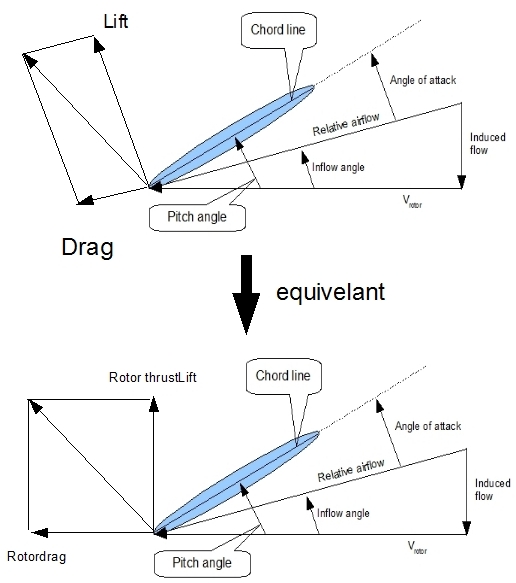
We will now put everything we have discussed together and look at all of the aerodynamic forces involved with a rotating blade around a shaft. This is set out in the figure below. We will firstly consider the position of the airflow. It
is the relative airflow which sets the angle of attack, which is in turn determined
by the horizontal
(as a result of rotor rotation) and vertical airspeeds, with the latter being the result of induced flow. Secondly, we will look at the forces which
play a role. These are the two components of the airfoil's reaction force: lift
and drag.
We must now take an important step forwards in our line of reasoning if we are to
take into account both the mechanical rotation around the shaft, and the torque
that must be provided by the engine to power the rotorsystem. Another force we are
interested in is the rotor's lift in the vertical direction (upwards). Formulated
in another way, we are now interested in the horizontal and vertical force components
which work on the rotating rotor, relative to the plane of rotation. This can easily
be done by breaking the reaction force down into the desired components, instead
of into the aerodynamic lift and drag elements. The two forces we are interested
in are rotor thrust and rotor drag. These are
defined as the force components orthogonal to the rotordisc (that is, 'straight
up') and the force components parallel to the rotordisc. Rotor thrust defines the
amount of vertical thrust (opposing the weigth of the helicopter). Rotor drag defines
the amount of torque that the engine must provide to keep the system rotating. Note
that the way we resolve the reaction force into its components is arbitrary from
a mathematical point of view, and the way that we have chosen to do so is for engineering
purposes (rotor thrust and rotor drag) instead of as a way to explain aerodynamic
behaviour (lift and drag).
Next topic > Rotordisc
|
Helicopter Theory (Paperback)
- This enormous tome provides comprehensive and detailed coverage of every aspect of helicopter theory. The purpose of the
book is to set out for the reader the engineering analyses required to enable the successful design of a rotorcraft. All relevant subjects,
such as vertical flight, forward flight, performance, rotating systems, rotary wing dynamics, aerodynamics and aero elasticity,
and stability and control are covered. They are explained at an in depth engineering level, always accompanied by accurate
mathematical analyses. A good knowledge of mathematics and a degree in engineering are necessary, as these topics are dealt with
extensively throughout the text.
- 1089 pages.
|
|
Principles of Helicopter Aerodynamics (Cambridge Aerospace Series) (Hardback)
- Modern treatment of the aerodynamic principles of helicopters and rotating-wing vertical lift aircraft
- Uses mathematics throughout the text
- Concepts are derived from basic enginering principals
- 864 pages
|
Comments are disabled.